

When you work in ecommerce, there are certain mistakes you start seeing so often that you almost recognize them before they appear. It doesn’t matter the platform, the catalog, or the industry: the same issues keep showing up and end up slowing growth without anyone noticing in time.
Inefficient category architecture
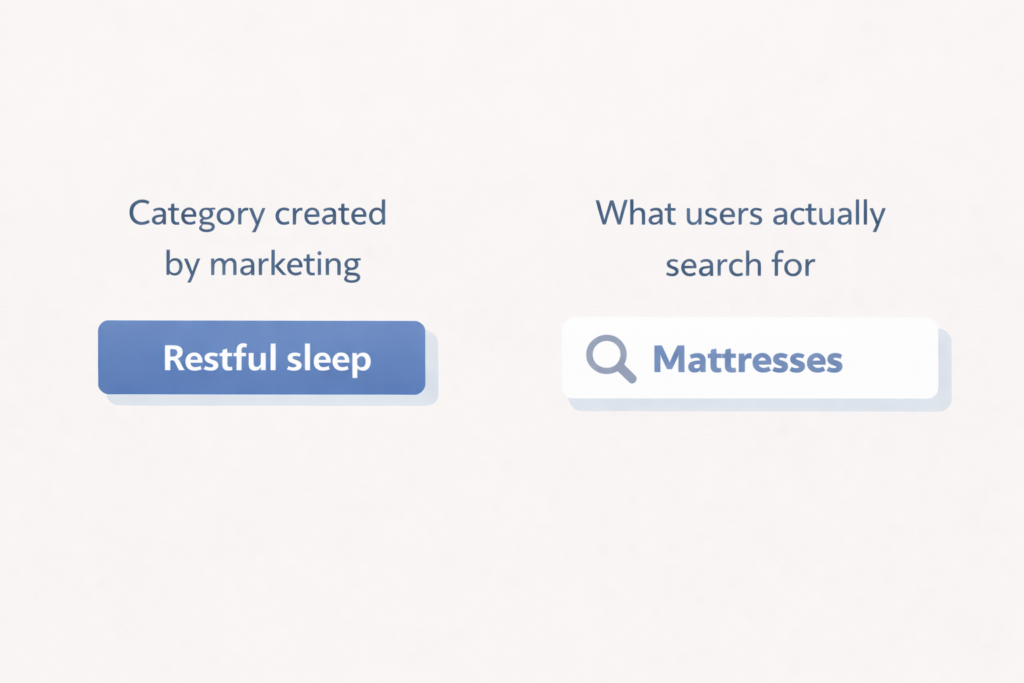
Many stores create their category tree based on intuition, on how marketing visualizes it, on how products are sold in physical stores, or on the structure sent by the supplier. But not on how users actually search.
This is a very common mistake and, in many cases, quite easy to fix. However, it keeps happening because the people managing the CMS don’t always have SEO knowledge, or because the teams responsible for the catalog don’t understand how their work impacts the visibility of the online store.
And this reveals another underlying problem: teams are not trained.
At Relevant we insist on this a lot, because when each area understands the basic principles of SEO, everything flows better and the company grows faster.
a) Clear structural errors
- Duplicate categories
- Illogical URLs
- Poorly placed products
- Pages that do not respond to any search intent
- Constant restructurings that break SEO
- Inconsistent or broken internal linking
b) Operational errors caused by poor architecture
- Accidental deletion of core categories that were ranking well
- URL naming changes without implementing redirects
- Changes in category structure without reviewing the SEO impact
- Internal menu or navigation adjustments without considering organic impact
A poorly built architecture generates indexing issues, weak internal linking, and a poor user experience. It is one of the most important pillars of ecommerce SEO, and at the same time one of the most misunderstood within ecommerce teams.
Filters, pagination, and parameters indexed without control
Ecommerce sites often generate thousands of URLs through size variations, colors, filters, infinite pagination, or parameters. If not controlled, Google’s crawler ends up crawling pages that add no value and only generate noise.
Typical mistakes:
- Meaningless indexable filters
- Indexed UTM parameters
- Sizes and colors generating thousands of URLs
- Missing or incorrectly configured canonicals
- Pagination interpreted by Google as endless content
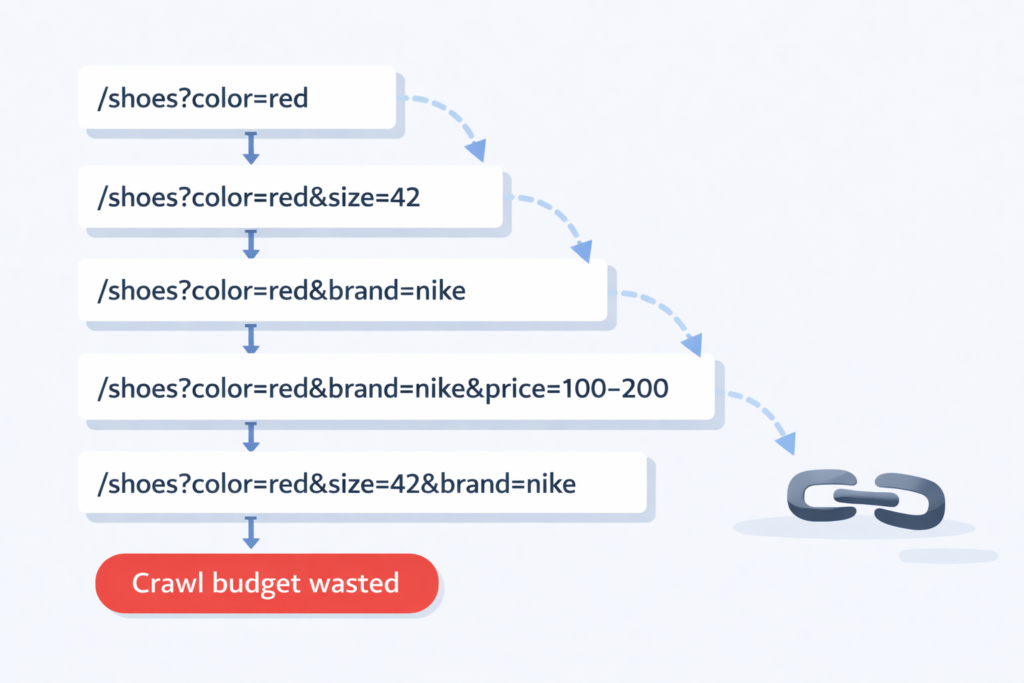
All of this consumes crawl budget and dilutes the relevance of the pages that should actually rank.
And here there is an important point: this part of the project cannot be fully delegated to internal teams, because they usually lack the tools and knowledge needed to detect these problems.
It is essential to have an SEO professional monitoring and reviewing these behaviors, because these technical details, if not properly managed, can completely stop the organic growth of the store.
Disorganized databases without clear patterns
This is the silent source of many problems and, honestly, one of the biggest headaches we’ve had at Relevant.
In some projects it has even become the biggest stopper preventing an ecommerce site from scaling. You can have good architecture, good content, and good technical SEO… but if the database is messy, everything falls apart.
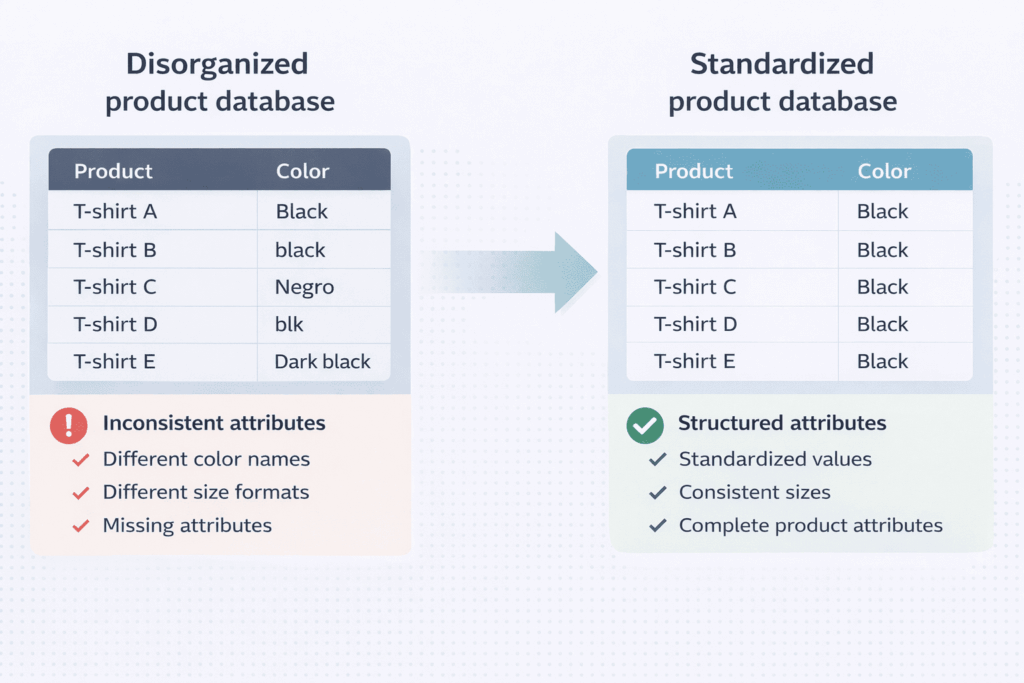
When product attributes come directly from manufacturers or supply chains and no one standardizes them, chaos appears:
- Five different ways to name the same color
- Inconsistent sizes between brands
- Descriptions without a common structure
- Missing key attributes (material, shape, finish…)
- Poorly configured product variations
A database like this makes it impossible to build strong categories, apply proper filtering, automate content, or maintain a stable catalog for both SEO and users.
Technical blockers that prevent creating categories or improving the site
“That can’t be done.”
“Neither can that.”
“That’s complex.”
“That requires development and will take two months (if we’re lucky).”
“That doesn’t fit in this sprint.”
At Relevant we hear this every day.
When an ecommerce site depends on the development team for every small adjustment, the ability to react disappears completely. And in SEO, reacting quickly is often the difference between capturing a trend or arriving too late.
These technical blockers slow down basic actions such as:
- Creating a new category to target emerging searches
- Building seasonal landing pages
- Adding new attributes to the catalog
- Adjusting filters or structures when search trends change
- Fixing issues that affect indexing
SEO requires agility. If every improvement requires complex development or months of waiting, the project becomes tied down and loses real growth opportunities.
Changes applied without involving SEO
Another common mistake in many ecommerce sites is making important changes to the website without communicating them to the SEO team.
It doesn’t matter if the change comes from product, content, development, marketing, or another team: if it’s published without reviewing the organic impact, it often creates problems.
Sometimes the changes are positive, but in other cases they cause issues such as:
- H1 modifications without criteria
- Internal links removed or altered
- Visible content being hidden
- New URLs without redirects from the old ones
- Reduction of indexable content
- Category or menu changes that break the architecture
These mistakes are very common because each team works “within their own area” without considering how it affects SEO.
That’s why we always insist that any area that touches the website should coordinate with the SEO team before publishing any change, no matter how small it may seem.
UX and CRO changes that ignore SEO
UX and CRO are essential to improve conversion rates. But when their decisions are implemented without aligning with SEO first, significant problems can arise.
Not because UX or CRO “do things wrong,” but because each discipline optimizes for different goals. If they are not aligned, one can unintentionally harm the other.
The most common changes that affect SEO are:
- Reducing content to simplify the interface
- Hiding important blocks behind collapsible elements
- Losing internal links due to redesigns or new layouts
- Visual hierarchy changes affecting H1/H2 structure
- Reordering elements that move relevant content
- Removing modules that provided semantic context
From a UX and CRO perspective, simplifying and focusing on conversion makes sense. From an SEO perspective, Google still needs to understand the page, its content, and its internal relationships.
When teams work in parallel instead of together, conflicts can appear:
- Pages that convert better but rank worse
- Content disappearing
- Categories losing visibility
- Implementation times doubling due to rework
That’s why it’s essential for SEO, UX, and CRO to collaborate from the beginning, share data, and define together which elements can be simplified without compromising organic visibility.
The catalog is defined by marketing, not by real demand
In many ecommerce businesses, new categories or product lines are created from marketing:
“We need it for paid.”
“It’s trending on social media.”
“It’s working well in physical stores.”
And all of that makes sense… but not from an SEO perspective.
SEO is guided by real user demand: search volume, intent, and query patterns. If there is no search demand, that category will not attract organic traffic on its own, even if it is useful for campaigns or branding.
The mistake is not that these categories “shouldn’t exist,” but that they are created without thinking about how to manage them so they don’t interfere with crawling or consume crawl budget unnecessarily.
From an SEO perspective we can:
- Prevent Google from crawling pages without value
- Control their indexation so they don’t saturate the crawl
- Create optimized versions if a real ranking opportunity exists
- Identify the exact keyword that can generate performance with a small keyword research
Many times, a quick analysis reveals a real search term that benefits both marketing and SEO.
In the end, these pages are often important for the business, but they require proper SEO management to avoid harming organic performance or crawl budget.
Poor communication between departments
This is probably one of the biggest obstacles to ecommerce growth.
Each team works in its own bubble:
- Paid launches campaigns without coordinating with SEO
- Social media creates content without amplifying SEO-driven blog articles
- Product changes categories without communicating it
- Development makes adjustments to the website without notifying SEO
And the SEO team only finds out once everything has already been done.
Usually this happens when traffic drops or rankings change, forcing the SEO team to investigate what happened.
In many cases, SEO is also asked to explain the drop in organic traffic and rankings, even though the change that caused it was implemented by another team.
The problem is not that each area has its own priorities. The problem is that information is not shared.
And in ecommerce, everything is connected.
For things to work, a 360° vision is essential. SEO, Paid, Marketing, Product, UX, CRO, and Development must work in the same direction, with fluid communication and shared criteria.
When this happens, the website grows. When it doesn’t, time, traffic, and opportunities are lost.
At Relevant we’ve experienced this so many times that we’ve integrated it into our methodology.
We usually propose:
- Specific meetings with each area to understand their reality and needs
- Quarterly project updates where each team shares what they are doing and their plans
- Connection points between areas so that no relevant change stays in a silo
- A clear communication channel where Development, Product, Marketing, and SEO talk before executing changes
These are not complicated processes, but they prevent many mistakes and help everyone move in the same direction.
SEO has too few hours assigned (and development even fewer)
In many ecommerce companies, SEO is still treated as a secondary task:
“Do it when you can.”
“We’ll look at it later.”
“We’re focused on another priority right now.”
The result is always the same:
- Endless backlogs
- Opportunities missed because the team arrives too late
- Technical issues taking months to fix
- Urgent changes that never enter the sprint
- Reactive strategies instead of proactive ones
When SEO is not truly part of the planning and has no resources assigned, it ends up becoming a patch.
And if development also doesn’t have time to implement what SEO needs, the project gets stuck, no matter how good the strategy looks on paper.
A series of errors
After seeing these mistakes across so many projects, one thing always repeats itself: SEO rarely fails for just one reason.
It fails due to an accumulation of small mistakes: poorly designed architecture, decisions made without search data, lack of coordination between teams, and technical problems that persist for years.
When an ecommerce company starts treating SEO as a strategic discipline instead of a secondary task, the change is enormous.
And very often, growth comes sooner than they expect. 🙂