

Google Marketing Live 2026: Every Google Ads Update You Need to Know
Once a year, Google gathers advertisers, agencies and digital marketing professionals to unveil the product roadmap that will define how paid advertising works over the next 12 to 18 months. This event is called Google Marketing Live, and it is the most important date on the calendar for anyone who manages or plans investment in Google Ads.
The 2026 edition has been the most significant in years. The central message is unambiguous: AI stops being an automation layer on top of campaigns and becomes the infrastructure that runs them. Every single announcement at GML 2026 points in the same direction — a world where users search, evaluate and buy without leaving Google’s interface, and where advertisers delegate creative control and targeting decisions to Gemini-powered models.
Here is a complete breakdown of every major announcement, organized by product area.
Search & AI Mode: The Biggest Transformation in the Channel’s History
Ads in AI Mode
The most disruptive announcement of the event. Google has been rolling out AI Mode — a conversational search experience powered by Gemini — directly inside Google Search. Instead of returning a traditional list of results, AI Mode generates a synthesized, reasoned response to the user’s query.
With GML 2026, that response can now include ads natively integrated within it. The ad does not sit above organic results in a fixed slot — it forms part of the generated answer itself, clearly labeled as advertising but contextually woven into the conversation. The format goes far beyond a standard headline and description: it includes reasoning about why that specific product answers the user’s specific question, verified pricing, stock availability and real-time ratings.
The critical technical implication is about measurement. In AI Mode, a user can read price points, compare features and reach a purchase decision without ever clicking. The conversion might happen days later via a branded search or a direct visit. A last-click attribution model does not capture this journey. CTR is no longer the primary success metric for Search — and every account running on the old measurement framework will systematically undervalue this inventory.
Ads in AI Mode does not have its own campaign type. It is served through AI Max and Performance Max. Eligibility depends entirely on the quality of signals the system has available: Merchant Center feed richness, Enhanced Conversions match rate, and CRM data imported via Data Manager.
AI Max for Search Campaigns
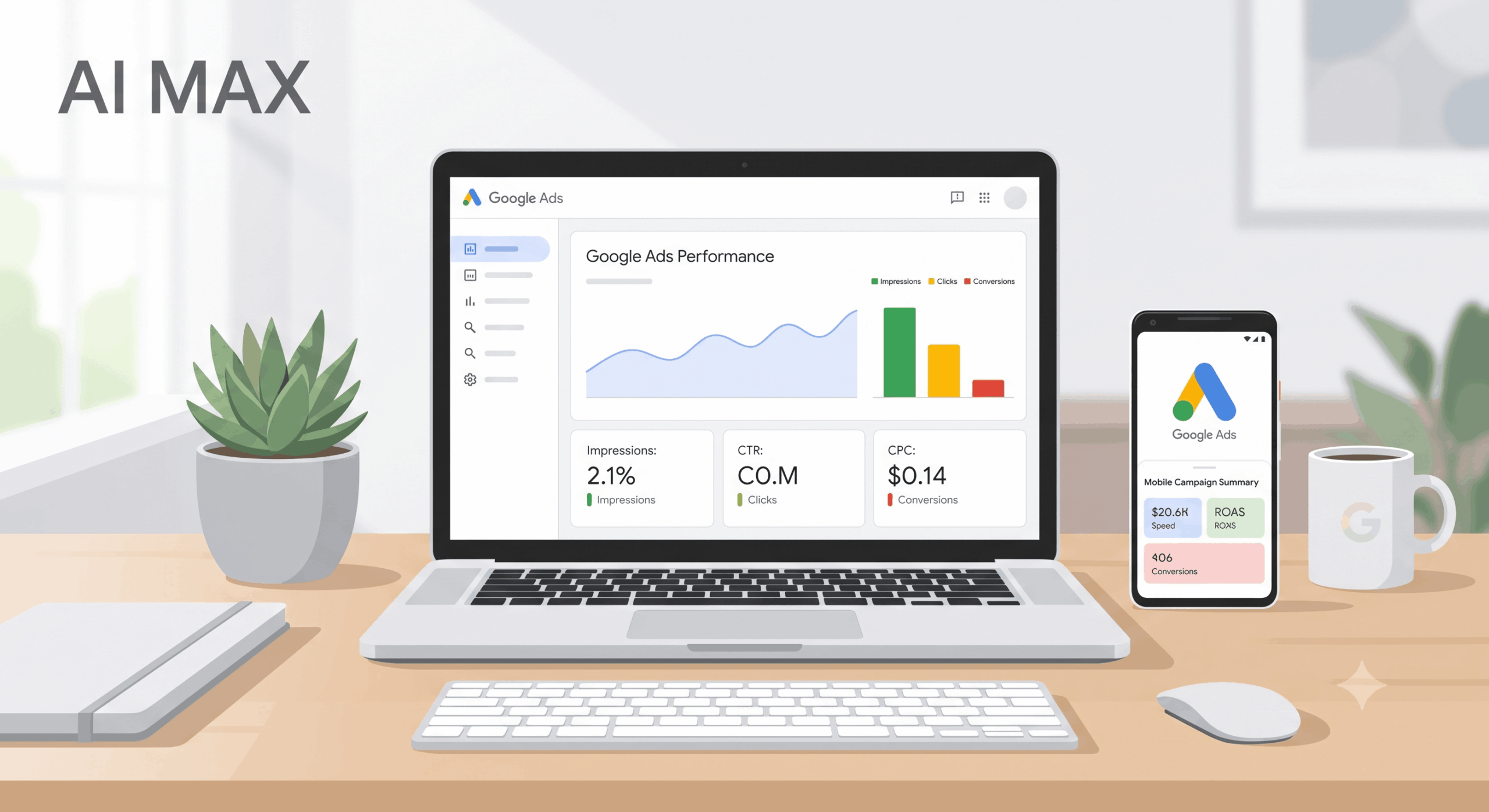
AI Max — launched in 2025 — receives two major updates at GML 2026: native AI Brief integration and new transparency controls. AI Max is the operating mode where the system automatically expands reach beyond configured keywords, adapts copy to each individual query, and selects the optimal landing URL. In GML 2026, this capability extends to Shopping campaigns, making the Merchant Center feed the single most important asset in any e-commerce account.
AI Brief
The new editorial control mechanism for the AI era. AI Brief allows advertisers to instruct Google’s AI in natural language — how to represent the brand, which audiences to prioritize, which messages to push. It replaces the granular management of keyword lists and match types as the primary lever of campaign control.
Business Agent for Leads
An AI agent that answers questions from prospective customers directly from the ad, in real time. Before a user even leaves the search results page, the agent can resolve objections, provide specific product details and qualify the lead. For B2B, education, financial services and healthcare, this directly impacts both CPL and downstream lead quality.
Journey Aware Bidding
The most significant Smart Bidding evolution since tCPA was introduced. The system now accounts for where each user sits in the sales funnel and adjusts bids accordingly. A cold prospect at the awareness stage and a hot lead close to closing will receive different bids even if they share the same keyword. For accounts with long B2B sales cycles, this changes how budget is distributed across the funnel in a fundamental way.
Smart Bidding Exploration
Extends campaign reach toward queries outside the account’s historical coverage, identifying incremental conversion volume while maintaining efficiency targets. Activate only once baseline CPA is stable — the initial exploration phase will temporarily inflate CPA as the model learns new traffic patterns.
Demand-Led Budget Pacing
Budget distribution is no longer linear. The system concentrates spend during the periods of highest consumer intent, generating irregular daily spend patterns. This is the system working correctly, not a budget delivery problem. Measure ROAS and CPA at the weekly or monthly level, not day by day.
Campaign Total Budgets
Assign a single total budget for the entire campaign flight instead of managing it daily. The AI distributes it according to demand patterns over the period. Directly eliminates one of the most repetitive manual tasks in account management.
Missed Opportunity Reporting
A new visual report that quantifies in economic terms the conversions lost to budget or bid constraints. Beyond being a diagnostic tool, it is a ready-made, data-backed argument for budget increase conversations with clients or internal stakeholders.
Improved Click-to-Call with Gemini
Gemini analyzes incoming phone calls to identify high-quality leads, filter non-commercial calls and surface which ad messages are driving actual sales. For verticals where phone calls are a primary conversion point — healthcare, legal, real estate, automotive — this is a direct improvement in the quality of the conversion signal feeding Smart Bidding.
RCS Message Ads
Message ads now support RCS (Rich Communication Services), the advanced messaging standard replacing SMS. Enables verified two-way conversations directly from the ad, with richer format capabilities and higher delivery rates than traditional SMS.
Shopping & Commerce: The Feed Is Now the Campaign
AI Max for Shopping Campaigns
The most important change for e-commerce accounts in GML 2026. AI Max extends to Shopping, transforming the Merchant Center feed into the campaign engine. The system matches conversational queries from AI Mode against catalog products without keywords — interpreting user intent and crossing it with product attributes to generate the ad dynamically.
The direct consequence: feed quality is now the primary optimization variable in a Shopping account, more important than campaign structure or bid strategy. Generic titles, thin descriptions and incomplete attributes cap the system’s ability to appear in AI Mode queries. Google has introduced Conversational Attributes alongside this launch — new feed data types designed specifically for conversational matching: use cases, usage context, material composition, compatibility notes, and functional benefits. Products with these attributes correctly populated can surface for queries that would be impossible to cover with a traditional keyword-based feed.
Universal Commerce Protocol (UCP)
The most strategically significant announcement of the event. UCP is the infrastructure that enables users to research, compare and complete a purchase directly inside Google’s environment — in AI Mode, on YouTube, within Shopping — without leaving the platform or visiting the advertiser’s website.
It includes a universal multi-brand cart, loyalty and member pricing for returning customers, and one-click cart transfer to the retailer’s site. Available initially in the US, Canada and Australia, with UK expansion during 2026.
The trade-off is real and worth evaluating carefully before activating: UCP reduces checkout friction and increases conversion rate, but the advertiser loses access to behavioral data generated during the purchase process — data normally captured in their own checkout flow. Implementing UCP requires a clear-eyed assessment of the first-party data strategy impact.
Ask Advisor for Merchant Center
A conversational AI agent that allows advertisers to diagnose and optimize their feed in natural language. It identifies low-visibility products, detects attribute errors, surfaces optimization opportunities and can execute changes directly from the conversational interface. For accounts managing feeds with thousands of SKUs, this collapses diagnosis time from weeks to minutes.
AI Performance Insights
Crosses catalog visibility data in AI search against real market demand signals to identify product-level coverage gaps. It answers the question every e-commerce manager needs answered: which products with genuine demand are losing visibility, and why?
Product Value Adjustments
Assign differentiated conversion values per product based on gross margin, expected LTV or strategic priority. Smart Bidding then optimizes toward real profitability rather than gross revenue. For accounts with highly heterogeneous margins across categories, this single change can materially improve campaign economic performance.
Direct Offers
Surface discounts, promotions and member pricing directly in the ad before the click. Reduces decision-stage friction and improves conversion rates in price-competitive categories.
YouTube & Demand Gen: Video as a Full-Funnel Conversion Engine
Checkout Links
Video ads can now direct users straight to the checkout process, bypassing product pages and intermediate funnel steps entirely. The intent generated by a video ad converts into a transaction in the fewest possible steps. For e-commerce brands with YouTube investment, this is the highest-priority activation from GML 2026.
Affiliate Partnerships Boost
Brands can now amplify within their Demand Gen campaigns the videos that creators and affiliates have already published about their products. The paid campaign incorporates creator content as a first-class asset, combining the credibility of the organic format with the reach of paid media investment. Creator-based ads consistently generate higher CTR and lower CPM than direct brand formats.
Creator Videos in Asset Picker
During Demand Gen campaign setup, the platform automatically identifies and recommends which creator videos have the highest performance potential for boosting. Reduces manual creator discovery time and minimizes the risk of selecting low-potential creatives.
Google Maps in Demand Gen
Demand Gen inventory now extends to Google Maps. For businesses with physical presence — retail, restaurants, local services — this opens a new paid channel in a context of high visit intent.
Product Videos at Scale + Multimodal Video Creation
Connects the Merchant Center catalog with the video format to generate dynamic product ads at scale — each automatically adapting to the most relevant SKU for each user, without manual per-product production. Asset Studio complements this by generating multiple video ad variants from a single concept brief, directly attacking creative fatigue at its root.
Campaign Type Attribution
Differentiates conversion attribution across the different campaign types active within Demand Gen. Enables more precise calibration of each format’s real weight in the conversion path and more accurate budget distribution decisions.
Demand Gen Uplift Experiments
Automated incrementality tests that measure the causal impact of Demand Gen campaigns on conversions. By comparing exposed and unexposed user groups, the system isolates the real campaign effect from organic consumer behavior — providing the evidence base needed to justify Demand Gen budget to stakeholders.
Measurement: Building the Post-Cookie Infrastructure
This is the most structurally important block of GML 2026 for long-term account performance. The measurement landscape has been in transformation since the deprecation of third-party cookies, iOS ATT restrictions and evolving European privacy regulation. Google has built out a comprehensive ecosystem of solutions to address the signal loss this creates.
Google Tag Gateway
A server-side tagging solution that improves conversion measurement resilience against ad blockers, Safari ITP (which limits cookie lifetimes to 7 days) and third-party JavaScript restrictions. Implemented in the advertiser’s own infrastructure, it acts as an intermediary between the user’s browser and Google’s servers. Typical impact after implementation: recovery of 15–30% of previously unregistered conversions. This is the highest-leverage technical action available in any account today. Without it, every AI model in the platform — Smart Bidding, AI Max, Journey Aware Bidding — is optimizing on incomplete data.
Enhanced Conversions — Update
Uses data provided directly by the user during the conversion event (email, phone, name) to match Google profiles and improve attribution without relying on cookies. GML 2026 updates expand coverage and improve match rates in iOS environments. The minimum useful match rate threshold for meaningful Smart Bidding impact is 40% — below that, the signal contribution is marginal.
Data Manager
A centralized hub for connecting all advertiser data sources into Google Ads: CRM systems, offline conversion events, propensity signals, first-party audience lists. It is the integration layer that enables the platform’s AI models to operate with the full picture of business data, not just what the conversion tag captures.
Meridian GeoX
Google’s open-source geographic incrementality experiment tool. It divides the territory into comparable geographic cells, assigns advertising investment differentially across them, and measures the conversion delta to calculate the real causal impact of campaigns. This is the most rigorous method available for answering the question every advertiser ultimately needs answered: how much revenue is the campaign actually generating?
Meridian Studio
An interface built on Google Cloud for building, customizing and scaling Media Mix Modeling (MMM) models. It allows running multiple models simultaneously across different clients, markets or business units. MMM is the only measurement methodology that delivers a complete cross-channel view of marketing ROI without relying on cookies or individual user identifiers.
Attributed Brand Searches
Measures the lift in organic branded searches attributable to exposure to demand and video campaigns. Quantifies the halo effect: the advertising that did not convert directly but generated deferred intent in the form of subsequent branded search. The essential complementary metric for correctly evaluating Demand Gen and YouTube performance — without it, these channels are systematically undervalued in any attribution model.
Qualified Future Conversions
Connects short-term user actions with transactions that occur weeks later. Particularly relevant for high-consideration purchase categories with long decision cycles — consumer electronics, financial products, automotive, real estate, education — where standard attribution systematically undervalues the channel that initiated the journey.
Lead Intent Scores + Lead Journey Mapping
Automatic quality scoring of each generated lead based on behavioral signals captured at the conversion point. Feeds Smart Bidding with lead quality information so the system optimizes toward leads with high close probability, not just raw volume. Lead Journey Mapping visualizes the complete path from first ad impression to closed sale, integrating CRM pipeline stages with Google Ads data.
Store Sales
Connects Google Ads investment directly with sales registered at physical point of sale, via TPV transaction data integration. Closes the online-to-offline attribution loop for retailers with physical presence and delivers a real omnichannel ROAS figure.
Apps & Mobile: Robust Signal in the Post-ATT Ecosystem
App Connect
Unifies the complete app experience across all Google surfaces — Search, YouTube, Discover, Play Store — in an integrated system that shares conversion signals, audience data and deep links across campaigns. Eliminates the fragmentation between acquisition campaign performance and downstream in-app behavior.
iOS App Campaign Advancements
App campaigns on iOS have operated with degraded signal since ATT implementation in iOS 14.5. GML 2026 improvements include more robust SKAN-compatible signals, bidding strategies adapted to Apple’s privacy framework, and improved modeled conversions for unobservable events. Designed to recover performance in iOS without requiring changes to the user consent framework.
Deep Link Agent
An AI agent that automates the technical configuration of deep links — the links that route users to a specific in-app screen rather than the app’s home screen. Deep links are one of the highest-impact factors for app campaign conversion rates, and manual implementation has historically been a significant technical bottleneck. The agent reduces configuration time from days to minutes.
Creative & Agentic AI: Asset Studio and Ask Advisor
Asset Studio
A centralized hub for the complete creative asset lifecycle: ingestion of existing brand content, AI-generated creative variants via Gemini, integrated A/B testing, and performance analysis by individual asset. It unifies in a single environment what previously required navigating multiple tools and workflows.
Multimodal Asset Generation
From a natural language brief or existing brand assets, Gemini generates images, short-form video and ad copy that automatically comply with Google’s advertising policies. The system produces format, aspect ratio and duration variants optimized for each placement without additional manual production effort — directly addressing the creative volume and refresh rate demands of modern Paid Media.
Creative Insights & Testing
An A/B testing framework for creative assets built directly into the campaign workflow. Identifies which creative elements — format, color palette, message, call to action — have the greatest measurable impact on performance metrics, with findings surfaced in the same interface used for campaign management.
Ask Advisor — Google Ads, Analytics & DV360
The most operationally far-reaching launch of the entire event. Ask Advisor is a cross-platform AI agent that operates simultaneously across Google Ads, Google Analytics 4, Merchant Center and DV360. Via natural language prompts it enables: campaign performance analysis, anomaly detection, automated report generation, configuration changes, period-over-period comparisons, and technical problem diagnosis.
The operational shift this implies is significant. Tasks that previously required navigating multiple interfaces, exporting data to spreadsheets and applying manual filters are now resolved with a single prompt. For agencies managing multiple accounts, the efficiency impact is immediate and material. More broadly, Ask Advisor marks the shift of the Paid Media specialist’s role — from manual execution toward strategic direction, briefing and supervision of AI-driven outputs.
What This Means for Paid Media Professionals
GML 2026 does not announce optional enhancements. It announces a structural shift in how Google Ads works. The accounts that will outperform in this environment are the ones that get the data foundation right first — Google Tag Gateway, Enhanced Conversions with a match rate above 40%, and a properly structured Data Manager setup. Everything else — AI Max, Journey Aware Bidding, Ads in AI Mode, Conversational Attributes — is built on top of that foundation.
The role of the Paid Media specialist does not disappear in this new environment. It moves upstream: from bid adjustments to signal architecture, from keyword management to AI briefing, from click-based measurement to causal impact analysis. The technical skill set shifts, but the need for human judgment, strategic thinking and rigorous measurement discipline becomes more important, not less.
The accounts that understand this shift and act on it now will have a compounding performance advantage over those still managing Google Ads the way they did in 2023.

10 articles published on the Relevant Group blog.
Latest articles by Javier